
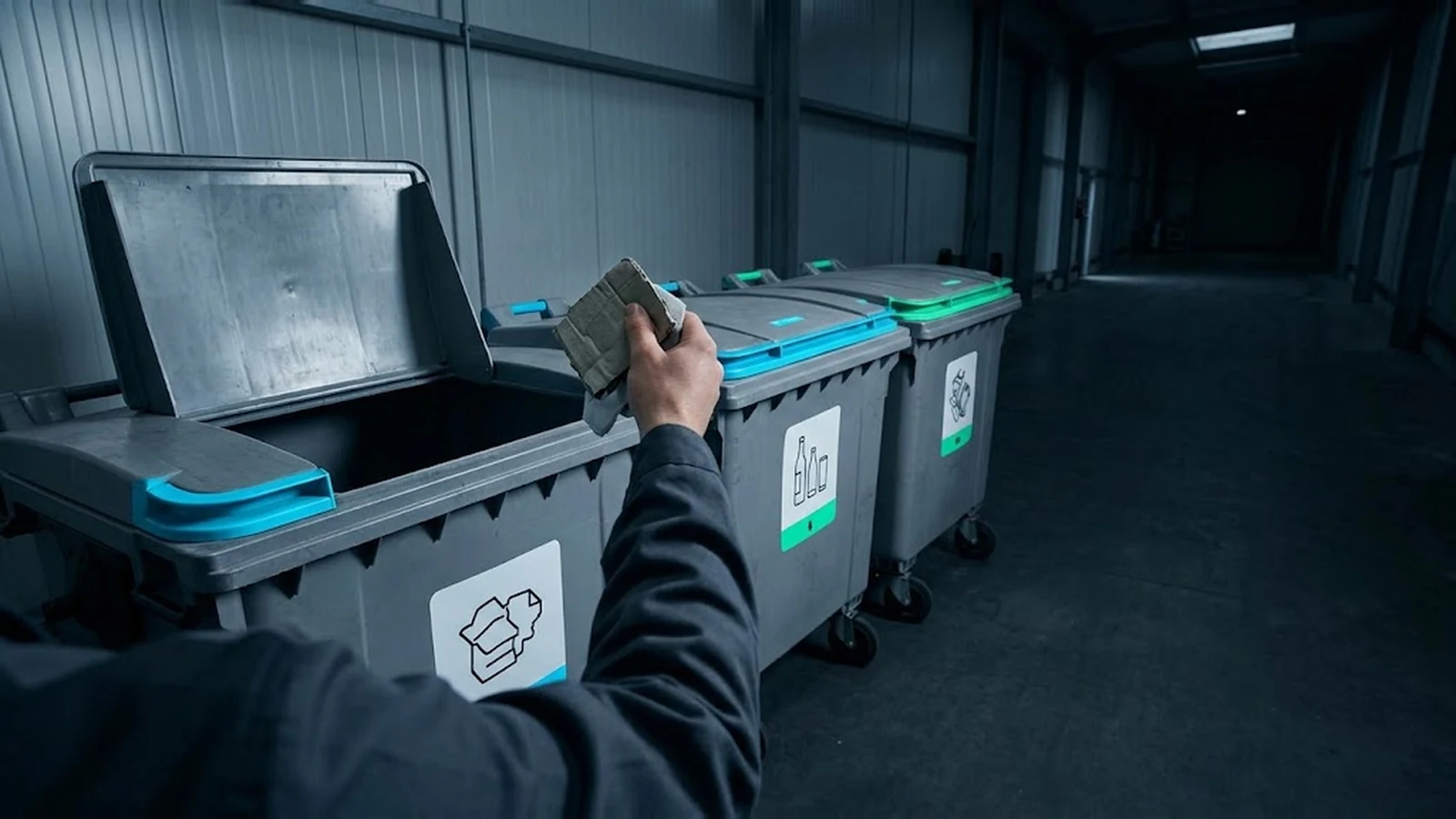
Separating material where it is generated is the single highest-value intervention in most operations, because a clean stream has a destination and a contaminated one usually does not. It is also the intervention that most reliably decays within weeks of launch.
The reasons are consistent across very different sites, and almost none of them are about attitude.
Distance decides compliance
The strongest predictor of whether a stream stays separated is how far someone must walk to do it correctly. Beyond a few paces, compliance falls — not because people are careless, but because the correct bin competes with a task they are being measured on.
Before redesigning signage, measure the distance from each generation point to the correct receptacle. The fix is frequently to move a container rather than to run a campaign.
Capacity has to match the rhythm of generation
A container sized for average generation overflows during peaks. Once it overflows, the material goes into whatever is next to it, and the stream is contaminated for that collection.
Worse, it teaches a precedent. Having put cardboard in general waste once without consequence, there is less reason not to do it again.
Size containers for the peak, not the mean. Or increase collection frequency around known peaks — delivery days, shift changes, production runs.
Someone must own the handover
Segregation usually survives at the point of disposal and fails at consolidation. Material correctly separated into small bins gets combined when moved to the central area, because the person moving it has one trolley and four bins.
Follow the material from the first container to the final one before the contractor arrives. The failure is almost always at a transfer step, not at the bin.
The scheme must survive the people who built it
Programmes launched with enthusiasm often depend on one person noticing problems and correcting them. When that person changes role, the scheme degrades at the speed of ordinary turnover.
Build for indifference. If a scheme requires enthusiasm to function, it is a campaign, not a system.
What to check when a scheme is already failing
Walk the site at the busiest hour, not a quiet one, and look for:
- Contamination patterns — is one material consistently in the wrong stream? That points at one
generation point, not a general problem
- Overflow marks — material stacked beside a full container shows a capacity or frequency problem
- Improvised containers — a cardboard box being used as a bin means the provided system does not
fit the work
- Signage nobody reads — if signs are at eye level for someone standing still, but the work
happens while moving and carrying, they are decorative
The order of operations
Fix the physical constraints first — position, capacity, frequency, the transfer step. Then address information. Training delivered into a system that physically obstructs the correct behaviour produces frustration and a brief improvement.
A diagnostic worth running
Pick your most contaminated stream and ask, at the point where contamination occurs: what would make the correct action the easiest one? Not the most virtuous — the easiest.
If the answer is a container moved four metres, you have found a cheap fix. If it is a redesign of how material moves through the site, you have found something worth a longer conversation.
Which stream would you pick, and what is physically in the way?
Written by ezero-waste. Any measured result carries its own scope and evidence.
Common questions
Why do segregation schemes decay?
Almost always for physical reasons — distance to the correct bin, capacity that cannot absorb peaks, or a transfer step where separated streams get recombined.
Is training the answer?
Not first. Training delivered into a system that physically obstructs the correct behaviour produces frustration and a brief improvement. Fix position, capacity and the transfer step first.
How do we diagnose a failing scheme?
Walk the site at its busiest hour and look for contamination patterns, overflow marks, improvised containers and signage positioned for someone standing still.