
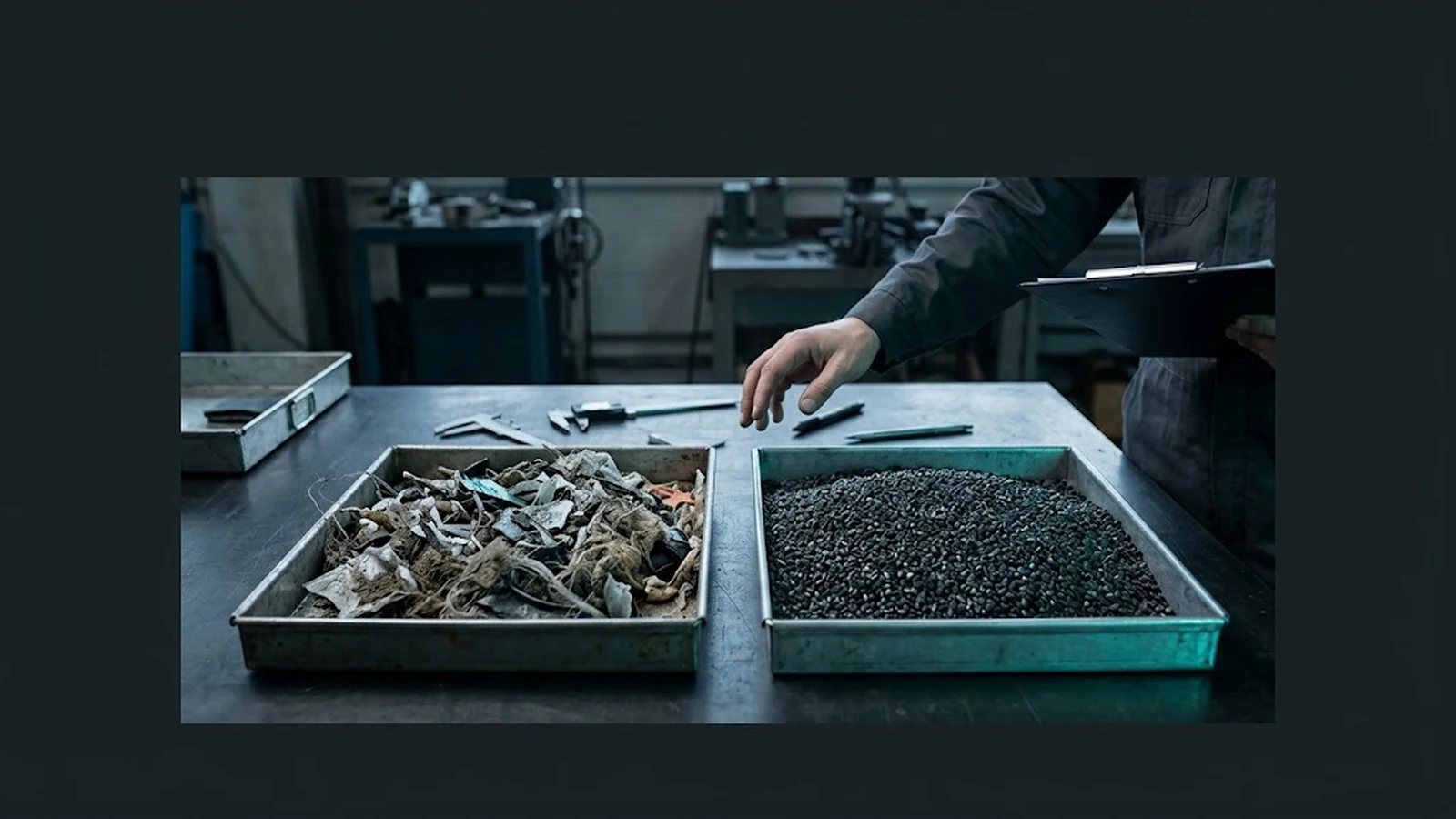
Most waste proposals read the same way. There is a commitment to circularity, a diagram with arrows forming a loop, and a promise of significant reduction. What is usually missing is the part that determines whether anything changes: which materials, measured how, over what period, and what you will hold in your hands at the end.
This is a guide to interrogating that gap — including when you are interrogating us.
Ask what the engagement actually covers
"Waste strategy" is not a scope. A scope names sites, material streams, a time period and a set of deliverables. Before signing anything, you should be able to answer:
- Which sites or lines are included, and which are explicitly not
- Which material streams are in scope — all of them, or the three that matter
- What period the assessment covers, and whether it reflects seasonal variation
- What documents you receive, and who inside your business can act on them
If a proposal cannot be reduced to those four answers, it is a statement of intent rather than a piece of work.
Ask how anything will be measured
This is where most engagements quietly fail. A consultancy that cannot describe its measurement method before starting will produce numbers you cannot defend later — to a board, an auditor, or a customer asking how you calculated a diversion rate.
Useful questions:
- Will measurement use weighed data, volumetric estimates, or contractor invoices? Each has
different error characteristics, and invoices in particular describe what was collected, not what was generated.
- How are mixed loads handled when a single container holds several materials?
- What is the baseline, and how was it established?
- What happens to the figures when production volume changes? A reduction that tracks a drop in
output is not a reduction in waste intensity.
Our own position: a measured result needs its own scope and evidence. The word zero in our name describes the ambition, not a claim about an outcome we have not yet measured with you.
Ask what happens after the report
A report that identifies opportunities and stops has moved the problem, not solved it. Ask who is responsible for each action, what it costs, what it depends on, and in what order the actions should happen. An opportunity nobody owns is a line item, not a plan.
Be suspicious of four specific claims
Treat these as prompts for evidence rather than reassurance:
- Certification language. Ask which body, which standard, which scope, and to see the certificate.
- "AI powered" or "fully traceable". Ask what the system actually is, what it measures, and who
enters the data. Software with manual entry at the front is a spreadsheet with a login screen.
- Carbon figures attached to waste outcomes. Ask for the conversion factors and their source.
- Guaranteed percentages before any assessment. A number promised before anyone has looked at
your material streams was not derived from your material streams.
We hold no certifications and operate no monitoring platform today. Saying so costs us nothing, because the work we do is not dependent on either.
What a credible first conversation sounds like
It is mostly questions, and most of them are about your operation rather than our method. Where does this material come from. Who handles it. What happens when it leaves. What have you already tried. What did you learn. A consultancy that spends the first meeting presenting rather than asking has decided what you need before finding out what you have.
A question worth answering internally
Before contacting anyone — us included — pick your largest or most expensive material stream and try to answer this: where does it go after it leaves your site, and how do you know?
If the answer is clear and evidenced, you may need execution rather than consultancy. If it is uncertain, that uncertainty is the most useful thing you could bring to a first conversation.
Tell us which stream you picked and what you found. That is a more productive opening than any proposal.
Written by ezero-waste. Any measured result carries its own scope and evidence.
Common questions
What should a proposal contain?
Sites and streams in scope, the period covered, the deliverables, and the measurement method. If it cannot be reduced to those, it is an intention rather than a defined piece of work.
Should we be wary of guaranteed percentages?
Yes. A figure promised before anyone has examined your material streams was not derived from them.
Do you hold certifications?
No, and we will say so. Where a question genuinely requires accredited certification we will point you to the body that issues it.